

„Indeed, if commoning has any meaning, it must be the production of ourselves as a common subject.
This is how we must understand the slogan “no commons without community.” But ‘community’ has to be intended not as a gated reality, a grouping of people joined by exclusive interests separating them from others, as with communities formed on the basis of religion or ethnicity, but rather as a quality of relations, a principle of cooperation and of responsibility to each other and to the earth, the forests, the seas, the animals.“
Silvia Federici
Clanz acts as a facilitator of commoning — a process oriented toward what in Italy is formalized as comunella, in German as Allmende, and more broadly understood in English as the commons.
By creating spaces for exchange, contribution, and shared access, Clanz prepares the conditions for forms of cultural and material co-production shaped through collective use and participation. In doing so, it fosters value beyond ownership and nurtures a local ecology of cultural production grounded in reciprocity, participation, and collective agency.
[01]
Ressources
The space of Clanz is both physical and social: rooted in the premises of the former trattoria De Maria e De Doro, and shaped through decades of practices of hosting and exchange. This evolving infrastructure — ranging from everyday tools and studio equipment to situated local knowledge and specialized expertise — forms the basis for encounters with incoming participants.
Through processes of negotiation and reciprocity, contributions take different forms: artistic restitutions by residents, financial participation sustaining and expanding the infrastructure, or forms of intellectual and cultural enrichment that strengthen the community of commoners, the growing network of cultural practitioners in the town, the wider region, and beyond.
- Informal hosting activitiesAn incomplete list of cultural workers, who have used their stays in the Clanz for concrete project work Heidi Specker / Photographerpreparation for her… Read more: Informal hosting activities
- Informal event activitiesThe Clanz was originally built to welcome people — hospitality and openness are part of the DNA of this former trattoria. Still today, it… Read more: Informal event activities
- Expats community buildingTrieste is often described as a shrinking city. At the same time, since the 2010s, interest in real estate investment from abroad has increased… Read more: Expats community building
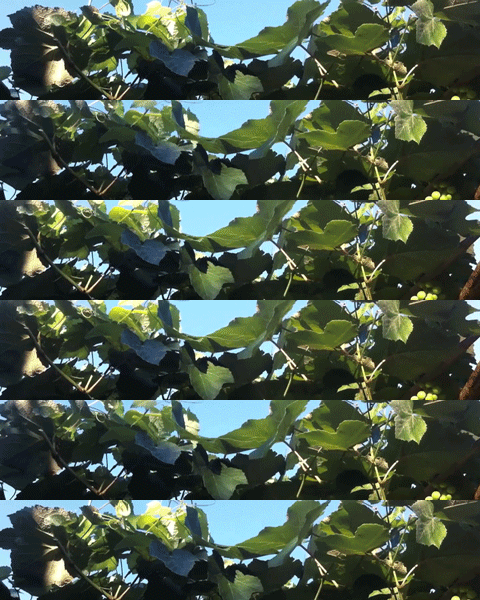
- FragolinoThe pergolas at Clanz are made from the traditionally widespread grape variety Isabella, the so-called American Grape or Fragolino. It is very resistant and… Read more: Fragolino
- SolarmanufakturSince 2018 every year around august 15 Irene Lucas, artist and expert in solar cooking, in team with Christoph Euler-Rolle, filmmaker and artist, and… Read more: Solarmanufaktur
[02]
Land
In closer relation to the historical notion of the commons, Clanz strategically (ab)uses the paradigm of property in order to loosen fragments of territory from the logics of trade and monetization.
Clanz initiates and supports projects that acquire rights to land and develops concepts for its collective, non-extractive, and inclusive use. In doing so, it seeks to open spaces in which territory can be understood not as property, but as a shared condition for cultural, social, and ecological practices.
- Rio MartesinThe steep hillside above the city — suspended between the Karst plateau and the sea — is cut through by the valleys of the… Read more: Rio Martesin
- Cernizza / črničjeThe former hunting grounds of the Counts of Thurn and Taxis form a walled forest characterized by ancient Mediterranean vegetation at the westernmost edge… Read more: Cernizza / črničje
- Orchard Scala SantaThe three pastini — traditional dry-stone terraces located in close proximity to Clanz — are officially designated as buildable land. However, limited access and… Read more: Orchard Scala Santa